The approval comes as Australia’s construction sector grapples with rising costs, labour shortages and mounting pressure to cut waste and carbon emissions.
Australia’s first project using a new modular structural system has received planning approval, marking the local debut of a construction technology that promises faster delivery, lower costs and a more circular approach to building.
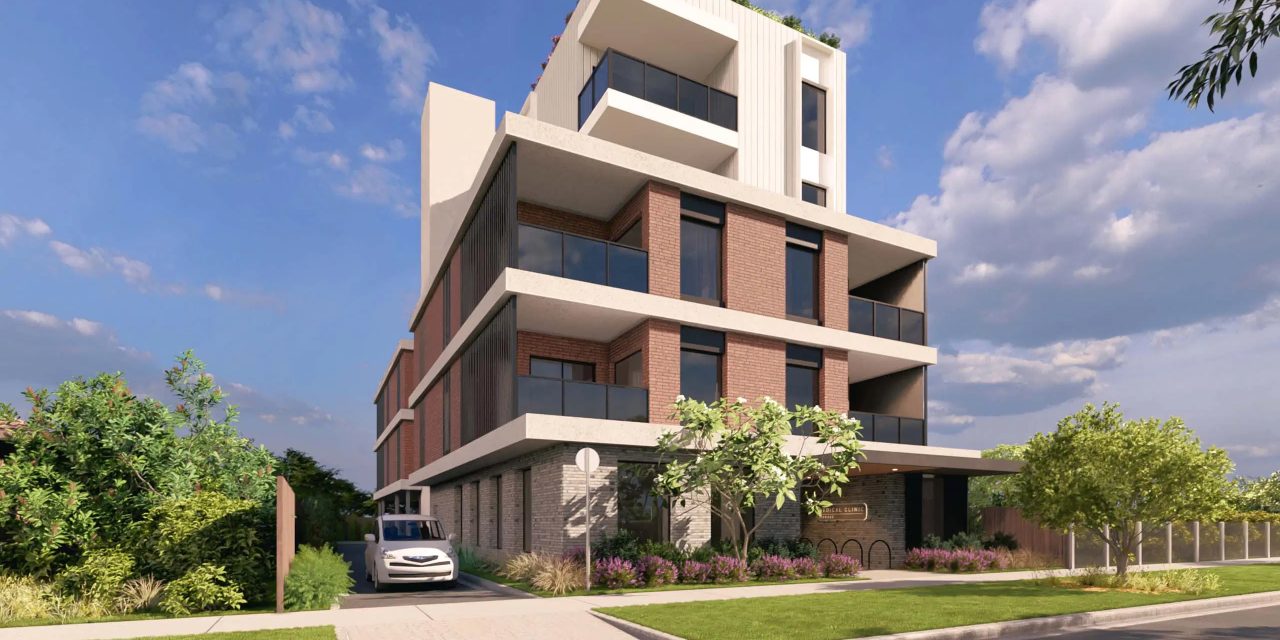
The five-storey NDIS Specialist Disability Accommodation development at 81 Henry Street in Pakenham, Victoria, is being developed by Gan Capital and designed by VIA Architects. Known as HVN Pakenham, it will be the first Australian project to use Autobox, a modular system developed by engineering consultancy
Australia looking to cut waste
The approval comes as Australia’s construction sector grapples with rising costs, labour shortages and mounting pressure to cut waste and carbon emissions.
Proponents of Autobox argue the system addresses all three, while avoiding the design compromises that have traditionally limited modular construction.
Unlike conventional modular buildings, which often rely on repetitive, stacked box forms, Autobox is a volumetric structural system capable of accommodating complex geometries and large clear spans. Modules can be transported flat-packed and then expanded into three-dimensional form on site, reducing freight volumes and easing logistics.
According to the project team, the hybrid concrete-and-steel system is about 30% lighter than traditional framing, lowering foundation costs. Three modules can be transported on a single truck, compared with one for standard modular construction, cutting transport requirements by about two-thirds.
On-site assembly of the structural frame is expected to take around two weeks, compared with roughly 10 weeks for a conventional build.
The full development is expected to be delivered in roughly half the time of a traditional construction program, with most mechanical and electrical services pre-installed off site and minimal construction waste generated.
Entire buildings can be dismantled, relocated, and reassembled
For Gan Capital founder Galen Gan, those efficiencies were critical to the project’s viability.
“With construction costs escalating, traditional methods simply weren’t stacking up,” he says. “Autobox gave us engineering certainty, speed and cost control without sacrificing design quality. For disability housing, that combination is particularly important.”
The time and cost savings have allowed the design team to focus on resident outcomes rather than value engineering. The apartments have been designed to meet NDIS SDA standards for High Physical Support and Improved Liveability, with adaptable layouts intended to support independence over time.
“Our aim was to create homes that feel chosen, not institutional,” says Graeme Heatley, senior associate at VIA Architects. “The system allowed us to prioritise liveability and accessibility, rather than compromise on design.”
Beyond speed and cost, Autobox’s most distinctive feature is its capacity for disassembly and reuse. The system is engineered so that entire buildings can be dismantled, relocated, and reassembled, potentially decades after initial construction. Advocates say this introduces a level of circularity rarely seen in the sector.
In contrast to conventional buildings, which are typically demolished at the end of their life with significant embodied carbon losses, Autobox structures are intended to be redeployed. Robert Bird Group estimates that reusing Autobox structures could cut the embodied carbon of future buildings between 60 to 80%.
“This is not just a sustainability play; it’s also a commercial one,” says CJ Wilson, the firm’s sustainability specialist. “It turns a building from a single-use investment into a redeployable asset, reducing long-term risk while delivering environmental benefits.”
Supporters argue the approach could reshape how Australia thinks about building lifecycles, particularly as governments and developers seek pathways to net-zero emissions. A building delivered today, they suggest, could be dismantled after 50 years, and reassembled elsewhere for another half-century of use, whether as housing, a school, hospital, or commercial asset.
As modular construction gains traction nationally, the Pakenham project is being closely watched as a test case for whether circular, reusable systems can move from concept to commercial reality.
Source: https://www.architectureanddesign.com.au/editorial/industry-news/australian-designed-circular-modular-structural-construction-idea-gets-planning-approval
Image: The five-storey NDIS Specialist Disability Accommodation development at 81 Henry Street in Pakenham, Victoria, is being developed by Gan Capital and designed by VIA Architects. Known as HVN Pakenham, it will be the first Australian project to use Autobox, a modular system developed by engineering consultancy Robert Bird Group. HVN Pakenham (render) / supplied.