
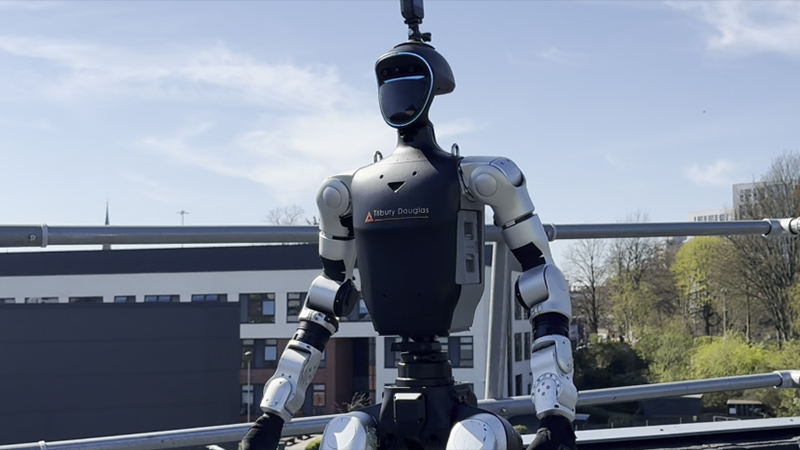
Tilbury Douglas has deployed a humanoid robot on a live construction site in what it describes as a UK first. The tier one contractor says the system has been introduced to carry out routine administrative tasks traditionally undertaken by site staff, including progress tracking and health and safety monitoring.
Equipped with cameras and laser scanners, the 30kg off-the-shelf robot can autonomously navigate the site to capture 360º imagery and generate point cloud data. Photographing areas from the same position each day enables the software to compare progress over time and flag deviations. If deployed from the start of construction, the data captured would create a continuous digital record of site activity.
What the robot does
The company estimates the robot will save about 40 hours per month by replacing daily site walks used to monitor progress, check installations and carry out safety inspections.
The trial is a positive step forward and a demonstration of what is now technically possible, says Professor Ioannis Brilakis, president of the International Association for Automation and Robotics in Construction, but it is not yet clear that it represents a major breakthrough.
The robot is not purpose-built to operate in construction sites, which are one of the most challenging environments to deploy in. Unlike warehouses or factories with level floors, fixed layouts and tightly controlled conditions, building sites are in a constant state of flux. The dynamic nature of construction requires dedicated R&D, rather than retrofitting existing products.
Tilbury Douglas’s use of an off-the-shelf solution reflects a broader pattern across the industry, says Brilakis, who is also director of the Construction Information Technology Laboratory at the University of Cambridge. “Rather than starting from a problem and looking for a solution, construction tries to find off-the-shelf solutions and see whether those solutions might also solve our problem. While that might work, and has worked in some cases, in many situations it doesn’t.”
He adds: “It’s not about the humanoid robot itself, or whether it’s actually autonomous… It’s about the process. Is the process getting cheaper, faster or safer, or are we achieving any other meaningful metric that shows we’re actually solving the problem?”
In this case, the focus is on administration and monitoring, which Brilakis describes as “low-hanging fruit” – structured, repeatable and relatively low-risk. These are not where the industry’s most acute skills shortages lie, however. According to the Construction Industry Training Board, the UK needs 61,000 additional construction workers each year to meet demand, particularly bricklayers, electricians, joiners and engineers.
The productivity case also warrants closer scrutiny, he says. While a saving of 40 hours a month appears meaningful, early-stage automation often carries hidden overheads. The human oversight required for automated systems can result in duplication rather than efficiency. “With many cases of robotic 3D printing, it requires more labour – people feeding the machine, supervising it, maintaining it – than doing the task manually at the outset.” The same question applies here: is the robot removing labour from the process or redistributing it?
Autonomy is central to the equation. “If you are delegating health and safety tasks to a machine, you need to be able to trust the machine,” he says. “There is a technological aspect to that, but there’s also a regulatory aspect.”
Construction operates within tightly defined frameworks, many of which still require human oversight and sign-off. Even if a system can reliably identify hazards or track compliance, the wider ecosystem might not be configured to accept its outputs. Changing that takes time. Brilakis cites building information modelling (BIM) as an example. Now widely embedded across the industry, BIM took decades to move from concept to mandated practice.
The absence of a clear market model is also a constraint. Unlike established construction equipment, where ownership, rental and utilisation models are well understood, emerging technologies such as robots sit in a more ambiguous commercial space. Questions remain over how systems are procured or hired, how value is measured and who ultimately benefits from their deployment.
These structural factors help explain why so much innovation in construction is incremental – heavy machinery, GPS-enabled earthworks, more powerful handheld tools – rather than step changes that fundamentally alter how projects are delivered.
Brilakis believes widespread adoption of humanoid robots in construction is still decades away, but he does see automation being embedded more broadly in the industry – just not on live building sites. Instead, he points to industrialised construction, including modular systems, automated fabrication and manufacturing-led approaches that shift complexity away from sites altogether.
“Off-site modular construction is so much more controlled, and it is easier to deploy automation there on permanent workstations,” he says. While a humanoid robot on a building site captures attention, he argues the more substantive gains will come in the shift towards off-site, factory-based production.
Image: The robot, named Douglas, has been introduced to support and assist site teams (Credit: Tilbury Douglas)