BIOSIS applied modular construction systems tailored for Greenlandic sites
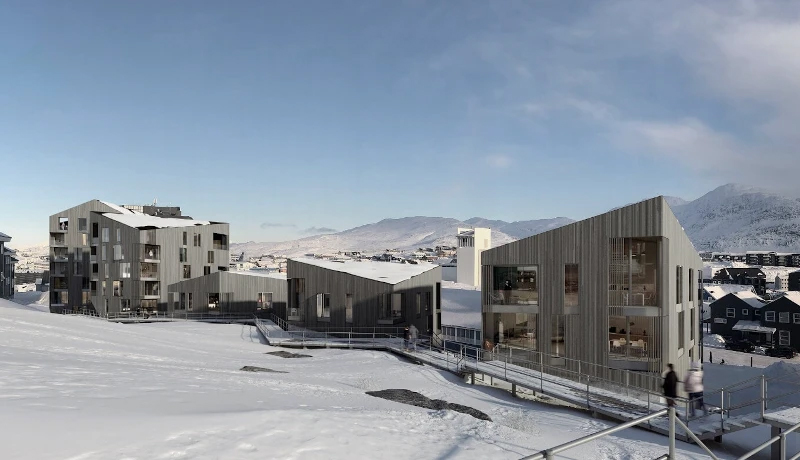
In Greenland, housing delivery is constrained by extreme climate, steep terrain, and short construction seasons. These conditions are most acute in Nuuk, where the population has doubled since 1980 and now exceeds 20,000 residents. With private land ownership prohibited and around half of Greenland’s 56,000 residents living in public housing, the Government of Greenland has prioritised new residential supply through long-term planning frameworks, including Kommuneplan 2028. Meeting this demand has required construction methods capable of operating within narrow seasonal windows and complex site conditions. (main image: Nuukallak 10, 45 modular housing units, Nuuk, Greenland. Image credit: BIOSIS.)
Designing for Arctic conditions
Modular and prefabricated construction has emerged as a practical response. Copenhagen-based architecture studio BIOSIS played a central role in this shift, delivering building systems developed specifically for Arctic environments. Founded in 2018, the practice applied elevated structures, timber framing, and factory-produced components to reduce construction risk and limit ground disturbance across multiple Greenlandic sites.
These methods address recurring challenges associated with permafrost thaw, coastal exposure, and steep or rocky terrain where conventional foundations are difficult to deliver. By transferring a significant proportion of construction activity offsite, projects were assembled efficiently during short summer building seasons while avoiding extensive blasting and large-scale concrete works.
Modular construction delivering housing at scale in Nuuk
Several completed projects in Nuuk demonstrate how modular construction has been applied across different residential densities. Nuukallak 10 delivered 45 apartments using prefabricated and modular techniques. At Qullilerfik, a further 46 units were completed on a site initially considered unsuitable due to its position along a sloping mountain ridge.
Modular design enabled five prism-shaped residential buildings to step with the terrain, maintaining daylight access, views, and privacy while keeping building heights aligned with the surrounding urban context.
The most comprehensive application of this approach was delivered through the Ningitsivik masterplan, developed by BIOSIS in partnership with Nuuk-based studio Titarneq. Located on a rocky coastal cliff, the completed plan included detached houses, townhouses, mid-rise residential buildings, and commercial space.
Timber-framed villas clad in salt-resistant wood were elevated on pilotis to minimise ground impact and adapt to coastal conditions. Angled building profiles responded to wind exposure and views, while the overall layout limited the footprint of development across the site.
Find:BIOSIS