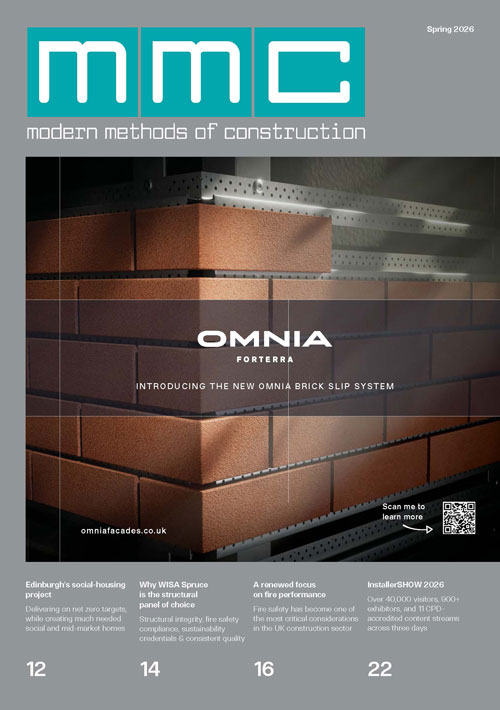
Martin Smithurst, product development and technical support manager at Forterra, explores how new product innovations can meet current project requirements while keeping known and loved traditional brick finishes.
The construction industry must find new ways to build in the current economic and political climate. Those involved in designing future buildings need to balance compliance with building regulations, the project’s sustainability, accessibility and safety requirements, the wants and needs of the client, and budgets, all while adhering to the design codes mandated at planning.
Rising costs mean that project teams are looking for different, more efficient ways to build to keep on top of tight budgets and timescales, without compromising on quality and performance, and they are turning to MMC solutions to help with this.
Across the industry, we are seeing a rise in modular construction, which incorporates panelised and volumetric construction. This is thanks to the Government’s push on new housing as well as major investments in new build, refurbishment and capital projects.
The continued rise of panelised construction
According to Barbour ABI, the UK panelised modular buildings market was valued at £1.26bn in 2024. Timber frame makes up the majority with approximately 70% of market share, but light gauge steel frame and hybrid modular solutions, such as CLT and precast concrete, are becoming increasingly popular.
Panelised construction addresses all the components designers are juggling. It also offers the very practical benefit that the construction of the building is less reliant on the British weather than more traditional methods, helping to significantly reduce build time.
From a sustainability perspective, the precision engineering and quality control carried out in a controlled factory environment deliver a consistent output. This, combined with the reduction of errors on site, ultimately means less wastage.
Building products and sustainability
The overall sustainability credentials of a project are increasingly impacting the choices made at the design stage. The products that are specified will make up a significant proportion of a project’s Scope 3 emissions, so designers need to find dynamic products that meet planning constraints and work on a practical level, while also helping them to meet sustainability targets. When you consider the sheer volume of product that is used on some buildings, this becomes even more of a challenge.
Modern masonry
Some of the reluctance to embrace MMC is linked to our country’s love of masonry construction, but opting to use panelised construction doesn’t mean that a genuine brick finish can’t be achieved.
Brick slip systems offer the benefits of traditional clay bricks, including long-term durability and simpler, lower-cost maintenance. However, as a lightweight system, brick slips lessen the load on the building’s structure, which in turn reduces the superstructure costs. This is particularly beneficial for mid- and high-rise buildings.
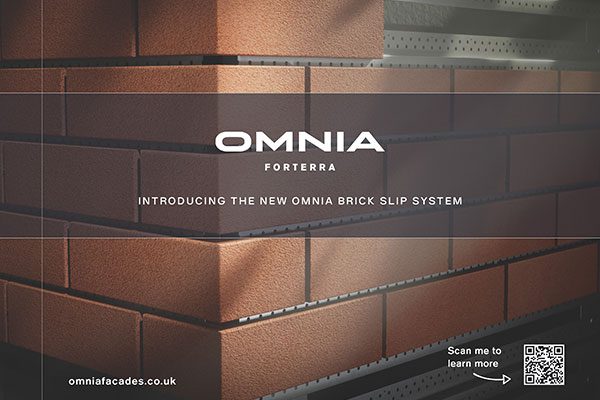
Omnia, a Forterra brand, has just launched its Mechanical Brick Slip system to complement its existing Adhesively-fixed Extruded Brick Slips. It is the first UK manufactured extruded brick slip system where the full system – including rails, fixings, and brick slips – can be sourced from a single supplier. It has been launched to help architects and specifiers meet the demand for innovative and sustainable ways of building while still achieving a traditional brick aesthetic.
The next phase of Omnia
 Omnia Adhesively-fixed Extruded Brick Slips were launched in December 2025, making Forterra the first major brick manufacturer to produce extruded clay brick slips at scale in the UK. Now, the full mechanical system is coming to market, making the specification process much simpler.
The slips mechanically fix to a steel single rail system to create a lightweight, A1 (non-combustible) rated rainscreen façade that is suitable for mixed-use mid- and high- rise developments and retrofit applications.
Designed to support MMC, Omnia combines the natural beauty of traditional brick with innovative construction methods to offer design flexibility alongside product performance.
Omnia Adhesively-fixed Extruded Brick Slips are designed to integrate seamlessly into prefabricated panels and modular systems, giving MMC manufacturers a dependable solution that supports efficient offsite production. With dimensional accuracy and uniformity through the extruded format, Omnia ensures consistency across panels, simplifying manufacturing and reducing quality-control issues
The Omnia Brick Slip System can also be incorporated into prefabricated panels and modular systems. The flexible rail system can accommodate different height and bond patterns, helping architects adhere to local design codes, even if modern methods of construction are being used to construct the building.
Seamless integration
Within the Extruded Brick Slip range there are two finishes available – Origin and Engobed – to help architects design facades that are in keeping with the local area. The Origin range showcases the natural colour and texture of clay, while the brick slips within the Engobed range have a durable-coloured coating applied pre-firing. This coating creates a broad and versatile colour palette, mirroring the most popular brick finishes in a range of reds, browns, monochromes and yellows, as well as multi and blue options.
UK manufactured brick slips
 The brick slips are manufactured at Forterra’s plant in Accrington using locally sourced clay. The renowned plant has been making bricks for more than 100 years. We’ve utilised the decades of brick making experience to develop an all-in-one system that can be used to reflect regional brick styles to let new facades sit seamlessly alongside traditional brickwork.
As a purpose-made, extruded brick slip system, the design of each slip has been precision engineered to reduce material waste and energy consumption. The system is also compatible with Omnia’s Soft Mud Brick Slip range, a selection of cut brick slips from the popular Measham brick range, giving specifiers a broader choice of finishes alongside Omnia’s extruded slips.
The system has undergone extensive testing. Fire testing was carried out by Warrington, building regulation structural testing by Lucideon, and CWCT Sequence B testing by UL Solutions. All of the test data has been independently verified by KIWA, giving architects and specifiers additional reassurance on system compliance and performance.
Combining a traditional aesthetic with modern construction
The urgent need to deliver new homes, schools and public buildings at scale is a familiar challenge for the industry. Moreover, the drive to create more sustainable, energy-efficient buildings while keeping costs under control adds further pressure to designers and contractors alike.
The opportunity to maintain a brick aesthetic provides the ideal solution for building designers to respond to the local design vernacular across vast swathes of the UK, while simultaneously enjoying the multiple benefits of MMC.
For project specification guidance, contact Forterra’s sales team on +44 (0) 330 1231017 or slips@forterra.co.uk.