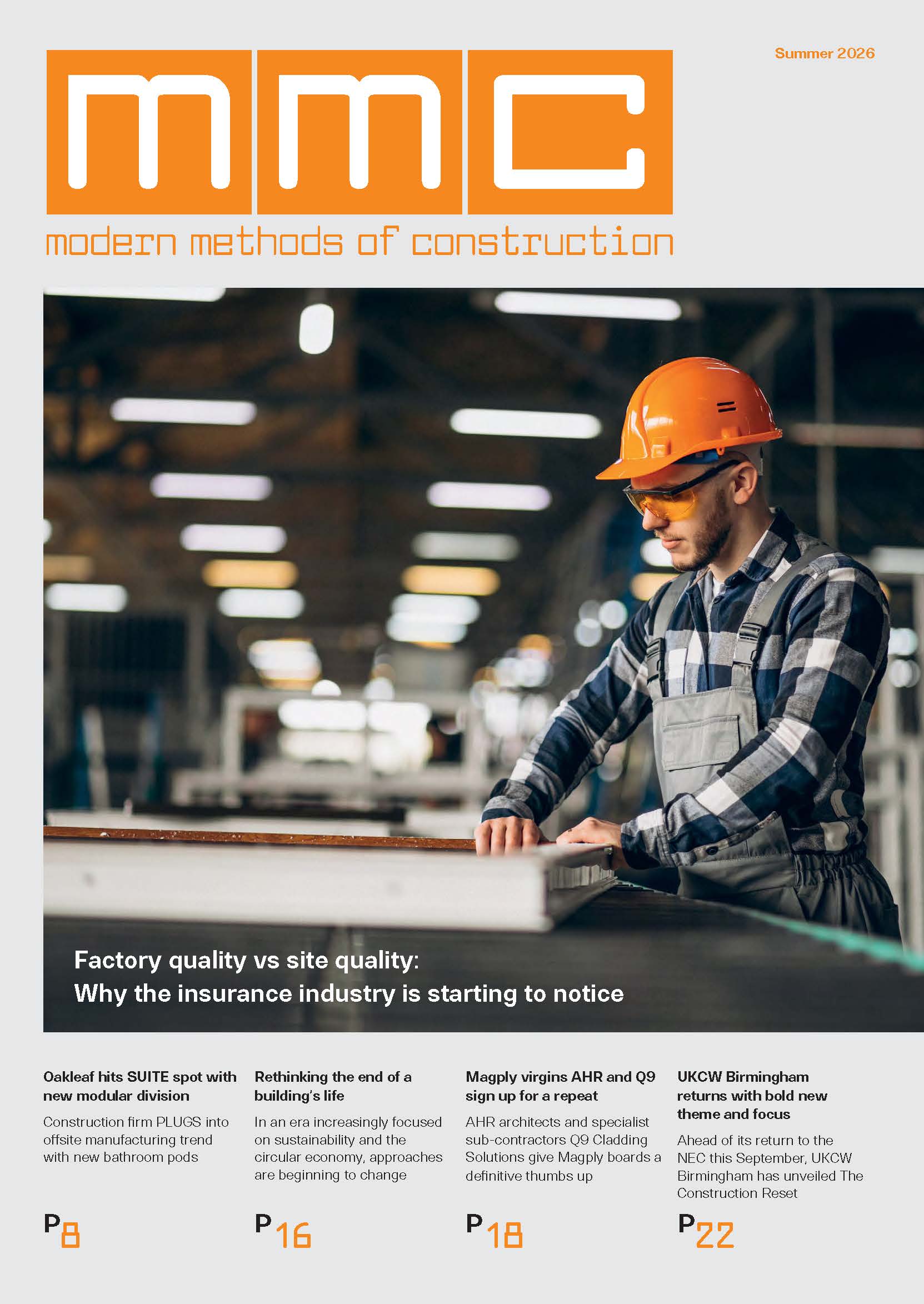

For decades, the construction industry has largely followed a familiar pattern: extract raw materials, manufacture products, construct buildings, and eventually demolish them when they reach the end of their useful life. While significant progress has been made in improving energy efficiency and reducing operational carbon, the way buildings are ultimately dismantled has received comparatively little attention. In an era increasingly focused on sustainability, resource efficiency and the circular economy, that approach is beginning to change. MMC Magazine Editor Joe Bradbury discusses:
Designing for Disassembly (DfD) is emerging as a concept capable of transforming how buildings are conceived from the very beginning. Rather than assuming a structure will one day be demolished, DfD encourages architects, engineers and manufacturers to design buildings that can be carefully taken apart, allowing components and materials to be reused, repaired, remanufactured or recycled with minimal waste.
Although still relatively niche within the UK construction sector, Modern Methods of Construction (MMC) are uniquely positioned to accelerate its adoption.
Offsite manufacturing already shares many of the principles required for successful disassembly. Factory-produced components are manufactured with precision, assembled through controlled processes and often rely on mechanical fixings rather than permanent site-based solutions. As sustainability targets become more demanding, this combination could provide MMC with another significant competitive advantage.
Moving beyond the demolition mindset
One of the key challenges facing the construction industry is the enormous amount of waste generated during demolition. Valuable structural steel, engineered timber, façade systems and mechanical services frequently become mixed waste streams that are difficult and expensive to recover. Even where recycling is possible, many materials are downgraded into lower-value products rather than being reused in their original form.
Designing for Disassembly seeks to retain the highest possible value of these materials. Instead of destroying components, the intention is to preserve them for future projects. Structural beams, wall panels, staircases, service modules and even complete volumetric units could potentially enjoy multiple service lives if they are designed with future removal in mind. MMC manufacturers are particularly well suited to this philosophy because their products are already manufactured as repeatable systems.
Standardisation allows components to be identified, catalogued and replaced more easily than bespoke site-built alternatives. This creates opportunities not only for maintenance but also for eventual recovery and reuse.
Why connections matter
Connections play a critical role in determining whether a building can be dismantled successfully. Traditional construction frequently relies on adhesives, welded joints, cast-in-place concrete and other permanent connections that make separation difficult. DfD instead favours bolts, screws, clips and other reversible fixing methods that enable individual components to be removed without damaging adjacent elements. This seemingly small design decision can have significant long-term implications. A façade panel secured with mechanical fixings can potentially be removed, refurbished and installed elsewhere. Likewise, a bathroom pod manufactured in a factory may be replaced without extensive structural work, reducing disruption and extending the lifespan of the wider building.
Mechanical and electrical services also benefit from this approach. Rather than concealing systems behind permanent finishes, designers can create accessible service zones that simplify maintenance and future upgrades. As building technologies evolve, heating systems, ventilation equipment and electrical infrastructure can be replaced more efficiently without extensive demolition.
Digital records for physical assets
Another important concept closely linked to DfD is the material passport. Essentially acting as a digital record, a material passport documents the origin, composition, maintenance history and potential reuse options for individual building components. Combined with Building Information Modelling (BIM), these digital records create an inventory that remains valuable throughout a building’s lifecycle. For manufacturers operating within the MMC sector, material passports could become an extension of existing quality assurance systems.
Every panel, cassette or module leaving the factory could carry a digital identity containing manufacturing information, certification, maintenance requirements and installation guidance. Decades later, building owners would still have access to this information when refurbishment or disassembly becomes necessary. This level of traceability aligns well with the increasing digitalisation of construction.
As clients demand greater transparency regarding embodied carbon and product performance, comprehensive digital records may become an expected part of project delivery rather than an optional extra.
Sustainability meets commercial value
 The growing emphasis on whole-life carbon assessment also strengthens the case for DfD. While operational emissions remain important, attention is increasingly shifting towards embodied carbon and resource consumption. Reusing structural components can significantly reduce the environmental impact associated with manufacturing replacement materials, helping projects meet ambitious sustainability objectives. Financial considerations are equally compelling.
Although designing for disassembly may require additional planning during the design stage, recovered components represent potential future assets rather than waste. A structural steel frame designed for reuse could retain considerable economic value decades after installation, altering how developers and investors evaluate long-term building performance. Insurance providers, lenders and investors may also begin recognising these benefits. Buildings that retain recoverable material value could present different financial characteristics compared with those destined for complete demolition.
As environmental reporting becomes more sophisticated, recoverable assets may eventually influence investment decisions and property valuations.
Building a circular future
Widespread adoption will require changes beyond design alone. Procurement practices, contractual arrangements and supply chain relationships will all need to evolve.
Manufacturers, contractors and clients must collaborate earlier in projects to ensure that disassembly principles are embedded from the outset rather than considered as an afterthought.
Standardisation will also become increasingly important. If components are manufactured using consistent dimensions and fixing systems, opportunities for reuse increase significantly. This represents another area where MMC already possesses considerable strengths. Factory production naturally encourages repeatability, quality control and dimensional accuracy, all of which support future recovery.
Education remains another important consideration. Many designers have been trained to prioritise permanent construction methods without considering future dismantling. As universities, professional institutions and industry bodies expand their focus on circular construction, awareness of DfD principles is likely to increase across the supply chain. There are already encouraging examples emerging internationally. Temporary buildings designed for relocation, modular educational facilities and adaptable commercial spaces demonstrate how flexible construction can reduce waste while extending asset lifespans. Although these projects remain relatively limited in number, they illustrate the practical feasibility of designing buildings for multiple future uses rather than a single fixed purpose.
Government policy could further accelerate adoption. As public sector clients increasingly prioritise net zero commitments, circular economy principles and whole-life value, procurement requirements may begin rewarding buildings designed for recovery and reuse. Such changes would naturally favour manufacturers capable of demonstrating traceable, recoverable construction systems.
The concept also aligns with the increasing popularity of adaptable buildings. Workplaces, healthcare facilities and educational environments frequently undergo significant internal changes during their operational lives. Components designed for removal allow layouts to evolve without wholesale reconstruction, reducing both cost and environmental impact. Importantly, Designing for Disassembly should not be viewed as an isolated sustainability initiative. Instead, it represents a broader shift in thinking about the entire lifecycle of buildings. Rather than treating construction as a one-way process ending in demolition, it encourages the industry to view buildings as collections of valuable resources that can be continually adapted and reused.
In summary
For the MMC sector, this philosophy feels like a natural progression rather than a radical departure. Offsite manufacturing already delivers precision, repeatability, digital information and quality assurance that traditional construction often struggles to achieve consistently.
By extending these advantages beyond project completion and considering what happens decades into the future, manufacturers can further differentiate themselves in an increasingly competitive marketplace.
As the industry continues its transition towards net zero, reducing operational energy alone will no longer be enough. Buildings will increasingly be judged by how responsibly they use materials across their entire lifespan, including what happens when their original purpose comes to an end. Designing for Disassembly offers an opportunity to rethink construction as a continuous cycle rather than a linear process. For MMC, it may prove to be not only the next evolution of modern construction, but one of its defining advantages for the decades ahead.