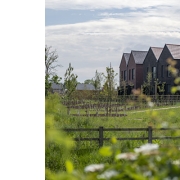
The next generation of new build homes has been introduced by Castle Green Homes.

Combining time-honoured style and materials with modern methods and digital technology, the homebuilder has revolutionised the way its homes are built and sold.

Headquartered in St Asaph, Castle Green is currently building and selling new homes at Bridgewater View at Daresbury Garden Village, Cheshire; Brook Meadow, Penyffordd, Flintshire; Orchard Place, Thornton, Sefton; and Mayes yr Haul, St Asaph, Denbighshire.

Across all its developments, the homes combine the best of old and new, both in their design and construction. Externally they’re inspired by the architecture of the Arts & Craft era, while inside they’re designed for modern living.

The homes are built using sustainably sourced, precision-made timber frames. Around a quarter of UK homes are currently built with timber frames, but they date back to medieval and Tudor times.

“Modern timber frames offer a fast, reliable method of building, with lower CO2 created than conventional building methods,” Stuart Andrew, design & planning director at Castle Green Homes, said. “Effectively, the timber frame system replaces the block work in the construction of our homes. The properties still look the same, with the advantage that build times are reduced, so our customer can move sooner. Plus, because timber framed homes are engineered to have lower air permeability and are generously insulated, this reduces the amount of energy needed to heat the home, making them potentially cheaper to run.”

Castle Green’s homes achieve an Energy Performance Certificate rating of A or B, making them among the most energy efficient available. Kitchens are fitted with energy efficient appliances. Eco labelled white goods such as dishwashers/ washing machines are provided or encouraged, all to A level rating.

The energy efficiency of a new Castle Green home increases the finance options available to our purchasers.

Sales and marketing director Caryl Russell said: “Research from the Home Builders’ Federation suggests those who live in a new house could save £2,200 a year on their energy bills*. The HBF found that new homes are 55% cheaper to run than older properties and predicts that when the Future Homes Standard come into effect energy bills for the average new build property will be 70% cheaper than their older counterparts. But it’s not just lower energy bills that our homeowners can enjoy.”

Caryl added:

“Homes with an EPC rating of B and above qualify to be purchased using green mortgages. Lenders tend to offer a lower rate with a green mortgage compared with a standard mortgage. This means that our homeowners can potentially enjoy long term savings on their monthly mortgage repayments. We can put buyers in contact with mortgage specialists who will help them understand the options available to them.”

Buyers at Maes yr Haul could find they have even more options available as selected homes there qualify for Help to Buy – Wales.

Designed to make homeownership easier to afford, Help to Buy – Wales is exclusive to new homes priced up to £300,000**. The Welsh Government scheme is only available with homes with an EPC B rating and above.

To purchase a home using Help to Buy – Wales, customers should only need a 5% deposit and 75% mortgage. The remaining 20% is covered by an equity loan, which is interest free for five years.

Further  research by the HBF suggests it costs more than £70,000 to bring a three-bedroom semi-detached home up to the same standard of a new build equivalent.

“The financial cost doesn’t take into account the time or the emotional investment renovating an older property requires including sourcing trades and finding suppliers,” Caryl said.

“Buy a new Castle Green home and you can select from a wide range of standard and upgrade options to customise it to your personal taste, then sit back while we take care of the hard work.”

Castle Green has revolutionised the home-buying journey with Willow, a digital new homes assistant. The innovative system has earned awards including the digital transformation category of the Marketing Week Awards and the best use of marketing technology category of the Construction Marketing Awards.

“Willow is industry-leading, providing our homeowners with a digital new homes assistant to support them throughout their homebuying journey and beyond,” Caryl added.

“Developments and homes can be favourited and compared to help you make the right decision for you and your family.  All documents relating to the purchase of your home will be completed and stored online, meaning you won’t have to worry about keeping them safe.”

Willow can be used to customise your Castle Green home by selecting choices wherever and whenever you want, including making payment for extras. There’s the ability to live “chat” with customer care and sales teams and to watch the 10-step progress of your home being built.

Caryl said:

“We have an extensive range of options available to our homeowners, subject to build stage and Willow gives them the ability to see and compare the various choices. We don’t simply offer computer generated images of what a house type looks like, we provide customers with a digital twin of their new home so they can see exactly what their specification choices will look like in their new home.”

Source: Business Wales

How Australia’s prefab industry can help the housing crisis

Prefabrication is a practical solution to meet Victoria’s urgent housing needs by providing speedy and cost-efficient dwellings

The Victorian government’s recent announcement that it’s aiming to build 800,000 new houses in a decade might seem very ambitious, but it aims to address a very serious problem.

Housing supply in Australia has not kept up with demand. There’s a national shortfall of housing, increasing interest rates which are creating significant levels of mortgage stress, spiralling rental prices and the large number of people now priced out of the housing market.

All of these factors are contributing to what’s now being described as a national housing crisis.

But could prefabricated modular construction – which basically involves producing standardised components or the whole of a structure in an off-site factory, then assembling them on-site – become a key part of the solution.

Our team sat down to look at some of the key issues and how prefab might help.

Dr Tharaka Gunawardena: How could prefab help tackle Australia’s housing crisis?

Due to the diminishing availability of skilled labour and the demand for quicker construction, prefab is fast becoming a necessity more than an option.

While providing the means to build houses with speed but with a reduced labour load, prefab can offer many more advantages.

It can allow construction with minimum on-site congestion, waste generation and pollution by moving away from a labour-oriented onsite operation to a more process-oriented offsite manufacturing and assembly process.

The fact that prefab units, especially volumetric modules (where the whole structure including finishes and fittings are manufactured offsite as modules), can be removed from the main structure for future reuse, relocation or repurposing is also a boon. This reusability contributes significantly to prefab buildings having a much lower life cycle energy.

Construction can also start earlier because prefab panels or modules can be manufactured in the factory while the onsite preparation and foundations works get underway.

Financially, investors in housing projects can start generating revenue much earlier and the construction process itself is significantly less vulnerable to adverse weather, which means projects are finished faster.

At the same time, advanced mass customisation methods in design and manufacturing allows architecturally unique housing designs to be built while allowing for mass manufacturing.

In all areas, prefab is a more than capable option in building high-quality dwellings in a short period of time.

Joyce Ferng: Does Australia’s prefab industry have the capacity to match the government’s housing ambitions?

Victoria’s housing goals align well with the PrefabAUS Prefabrication Industry Roadmap for 2023-2033, setting the stage for substantial economic benefits and cost savings associated with Smart Building, which aims to decrease construction time frames and waste while increasing quality, productivity and affordability.

The roadmap projects that Australia could earn an annual benefit of $AU9 billion by 2033, driven by the efficiency of Smart Building practices and prefabrication.

In the short term, prefabrication is a practical solution to meet Victoria’s pressing housing needs. Its ability to provide speedy and cost-efficient housing makes it a strong choice for the demands of both single dwellings and multi-residential buildings.

One piece of analysis points to Melbourne’s potential for 230,000 granny flats, a fast-track solution to housing shortages, thanks to prefabrication and the flexibility it offers in navigating town planning regulations.

This current surge in housing demand is a catalyst for elevating the prefab industry’s capacity and capabilities, from single dwellings to customised complex multi-residential buildings.But there also is the critical need for strategic initiatives and robust partnerships to provide a foundation for this burgeoning industry – providing answers to housing affordability, climate resilience and carbon reduction through energy-efficient design.

Professor Tuan Ngo: Is the current regulatory framework supportive enough to fast track this many houses this fast?

There is an urgent need for more comprehensive standards and guidelines for the design of prefabricated housing.

The importance of a reliable design approach for modular structures cannot be overstated, as an unsuitable design can significantly impact both project costs and timelines.

Currently, traditional ‘limit state design’ criteria, which includes stability, strength and serviceability, are the prevailing design practice for modular buildings. But the absence of comprehensive design guidelines for prefabricated modular buildings can mean these techniques, even when using innovative materials, fall short of expectations.

To ensure a safe and robust design, the design loads (like the dead weight of the structure, the weight of occupants and finishes, and other attachments or fittings) of any structure must take into account all potential circumstances. The design loads in modular construction are different from those in traditional construction because of their unique loading characteristics (owing to the transportation, lifting and handling stages of a prefab installation).

The construction process itself requires distinct infrastructure – demanding careful consideration of factors like geometric inaccuracies and installation procedures.

Offsite construction requires a highly detailed design at the early stages. This means the design requirements for modular buildings are significantly different from those of conventional structures.

But the current design of modular buildings mainly relies on a conventional design system and lacks the necessary design guidelines – so it’s imperative to establish and implement suitable design guidelines for modular prefabricated housing.

Professor Shan Kumar: Is prefab cost effective in the medium to high rise and multi-residential market?

If it’s well coordinated (by engineers, architects and prefab manufacturers), uses appropriate materials (timber, steel, concrete and other sustainable composites) and smartly executed by skilled prefab-modular contractors, then prefab construction will certainly deliver a cost effective, quality home on time.

More of these projects in the pipeline would encourage prefab contractors to invest in research and development, which in turn, would help achieve simple, smarter, innovative modern methods of construction.

To bring more building contractors into this prefab-modular construction space, there must be a mandatory skills requirement.

Government-initiated grants for research and development as well as low interest bank loans and tax credit initiatives for setting up prefab manufacturing factories would help create interest and reduce barriers to entry.

In terms of regulatory requirements, they must be made easy to make this smart construction a viable alternative to building affordable homes – not just in mid to high-rise apartments, but also in single dwellings and unit developments.

Upskilling the prefab-modular industry, which should start at the student undergraduate level, is the key to successfully getting the required number of affordable home projects completed on time.

Professor Priyan Mendis: In terms of research and development, has there been enough investment to allow these kind of rapid solutions for the housing crisis?

There is a genuine need for more investment into the research and development of modern methods of construction, with prefab as the base.

This need is real – both from the construction industry and academia.

The University’s Centre for Advanced Manufacturing of Prefabricated Housing (CAMPH) which, for five years, worked in strong collaboration with industry pioneers continues to disseminate its knowledge and expertise long after its conclusion.

However, many more areas – like advanced and sustainable materials, factory automation, robotics, financing and value chain issues – still need further development.

Unfortunately, recent trends in government funding have seen less and less attention given to research and development in the construction sector.

The urgent need to solve the housing crisis demands a more significant commitment in government funding to ensure that higher quality housing solutions are provided for future Australian homeowners.

Source: The University of Melbourne

Miranda Lepri details the Cavendish Laboratory’s role in the future of space-based solar power

As crazy as it may seem, the possibility of launching solar farms in space is becoming more science than fiction. As of this June, the University of Cambridge is one of eight institutions to receive grant funding from the UK government’s Space Based Solar Power Innovation Competition. The competition is part of the Net Zero Innovation Portfolio, which allocates funding to the development of low-carbon or renewable technologies and systems in order to realise the set goal of net zero emissions by the year 2050.

While solar energy has long been floated as a potential alternative to combustibles, several factors have stood in the way of its viability in eclipsing carbon-based fuel as a major energy source. For one thing, solar panels on Earth, particularly residential cells, often operate at somewhere between 17% and 20% efficiency, with the most advanced recent developments reaching closer to 50%. This is due to a variety of factors, not least including variations in weather conditions and limited daylight hours.

None of these would be factors in space, where a satellite in geostationary orbit about 36,000km above the Earth’s surface could continuously generate energy close to 24 hours a day. While most mid-sized solar plants, which includes all solar farms in the UK, cap out annual production in megawatts, space-based solar plants would easily deal in gigawatts – for context, one gigawatt (GW) is equivalent to 1,000 megawatts, and a potential 10GW annual generation capacity would account for ¼ of the UK’s net electricity consumption. Space solar farms would also greatly reduce the sheer amount of land required to generate solar power, with the UK’s largest solar farm inhabiting over 250 acres for a mere 72.2-megawatt maximum output.

When considered in these terms, space-based solar farms seem too good to be true. The technology is not without its downsides though, chief among them the longevity of the hardware in space, an environment which presents accessibility issues, as well as potentially prohibitive costs, when considering potential repairs. This is where the new research out of Cambridge comesin.

In partnership with programs at the University of Southampton and IQE PLC, a British company dealing in cutting-edge semiconductors, Cambridge’s Cavendish Laboratory is developing lightweight solar panels that will not deteriorate in the face of high levels of solar radiation. Louise Hirst, Professor of Material Physics at the University, and her team are currently working on the production of concentrator photovoltaic devices – solar technology that converts light into electrical energy – that are able to resist deterioration from radiation due to their ultra-thin nature and the implementation of integrated light management technology.

The ultra-thin solar cells resist degradation better than their thicker counterparts, as the charged particles carrying solar energy travel a shorter distance across the cell, offering fewer opportunities for the particles to strike, and thus degrade, the solar panel’s crystal structure. While thinner cells do have higher transmission losses, the addition of internal light management structures, such as textured, reflective surfaces within the solar cell, would help to optimise the solar panels’ energy production. The team will also apply a thin film coating to the prototypes, allowing the device to regulate its temperature by releasing excess heat into space.

Professor Hirst’s team is also working to minimise the costs of this new technology, enabling what Hirst described in a University press release as “a complete, technically feasible, robust, and relatively inexpensive solution for generating power from space”. The general decreasing trend in the cost of launching heavy cargoes into orbit will also ease the start-up cost of space-based solar farms in the coming years.

The potential for energy generation in space seems highly promising. This raises the question, though – how will this energy be transported back to Earth? The answer is, shockingly enough, microwaves. That’s right – the same science that heats up your pot ramen could transport gigawatts of solar energy from orbit to the Earth’s surface. Just this year, researchers at Caltech launched a prototype spacecraft and successfully transmitted solar power to Earth through the use of microwave technology.

To justify the costs of space-based solar farms, this technology must become highly efficient, rather than merely technologically viable, by retaining a significant portion of the energy generated in the transfer. This technology will need to develop alongside Hirst and her team’s lightweight panels in order to make space-based solar power a feasible source of renewable energy. The technology may not be ready to launch tomorrow, but for a 24-hour completely renewable energy source, with little to no carbon footprint here on Earth? We’re willing to wait.


Source: Varsity


Picture: credit Volo/Linkedin


The Queensland government has announced that seven prefabricated homes have been built at VOLO Modular at Yatala on the Gold Coast for delivery to Eidsvold this week.

According to a statement on Wednesday, the houses will be delivered by truck and as used as social housing.

VOLO will build 27 of the two-bedroom homes in total, with the first deliveries beginning this week.

VOLO’s Rick Bell said enquiries had doubled in the last six months as Queenslanders saw the benefits of modular homes, which included speed. He said they were put together in a quarter of the time taken for regular homes.

“Now we do the landscaping and build carports and those sorts of things, and the plan is that they should be ready to be occupied by Christmas,” he said.

The Queensland government had previously announced the work with VOLO as part of its affordable housing initiatives, calling the partnership a “first-of-its kind”.

One-hundred modular homes are being delivered by the end of the year through the Modern Methods of Construction program.

“These prefabricated homes are architecturally designed but take a fraction of the time it would take to build a home from the ground up, especially in regional communities,” said state housing minister Meaghan Scanlon.

“Modular homes are particularly beneficial for regional areas in Queensland, where construction can be challenging.”

Source: AuManufacturing


The Prime Minister’s controversial move to cut back many of the nation’s net-zero ambitions has received criticism from business leaders, environmentalists, and Conservative party backbenchers. Meanwhile, a new survey from energy company Vattenfall reveals a very different perspective from UK businesses, demonstrating their eagerness to decarbonise – without delay.

Rishi Sunak recently announced a major recalibration of the nation’s net-zero targets. Key changes include pushing back the 2030 ban on new petrol and diesel cars to 2023, and the 2025 ban on gas boilers to 2035.

While the government’s reasoning for this environmental U-turn is to save consumers money, Sunak’s justification has been met with serious scepticism. Former Prime Minister Boris Johnson urged that “we cannot afford to falter now or in any way to lose our ambition for this country”, and that “businesses must have certainty about our net zero commitments”.

Jim Watson, Director of the UCL Institute for Sustainable Resources, argued that the weakening of our sustainable policies is likely to add further costs onto businesses in the future, rather than cutting them. He commented “Rishi Sunak’s Net Zero speech is full of contradictions and will make it harder to meet our medium – and long-term climate change targets. It also risks increasing the costs by delaying the shift away from fossil fuels and reducing the economic benefits to the UK.”


UK businesses are driving decarbonisation regardless

According to a recent study conducted by Vattenfall Network Solutions, UK businesses are committed to their net-zero regardless of the changes: 95.5% of companies surveyed, with a workforce exceeding 50, stated that they are steadfast in their commitment to reducing carbon footprints or achieving Net Zero. A majority, 77.4%, aim for significant cutbacks by 2030, with 58.1% envisioning substantial reductions within the next 5 years, highlighting business’ understanding of the urgency and commitment to the net zero imperative. Vattenfall’s survey, engaging a thousand mid-sized industrial firms, demonstrates that UK business is committed to cutting emissions as soon as possible, despite the Prime Minister’s wavering.

Electrification is one of the most vital strategies for the UK to reduce its CO2 emissions in time for the2050 net-zero deadline, which also makes economic sense since electrical processes are often more efficient. But surprisingly, according to Vattenfall’s investigative report, only 51% of companies surveyed anticipate a rise in their electricity usage in the forthcoming decades. This statistic raises a serious question – where will business’s energy be coming from, if not from electricity? Evidently, a deeper understanding of the net-zero roadmap and its key steps is imperative to navigate the transition.

Energy efficiency is the most obvious way to reduce consumption and was the most popular method of achieving carbon reductions with 23.4% of companies targeting savings this way, whilst almost 70% (68.6%) of companies with carbon reduction or net zero targets included electrification, solar PV or changes in energy use as part of their plans.

The biggest take-away from Vattenfall’s survey was that a resounding 80% of respondents acknowledged the necessity of guidance to meet their targets, underscoring an industry-wide thirst for expertise, rather than a weakening of targets.

This massive demand for financial, technical and implementation support highlights UK businesses commitment to net zero and the urgent need for clear guidance and programmes to help UK companies deliver on net zero.

But, where the Government is failing to deliver, industry is pushing forward to deliver on the urgent net zero imperative. Vattenfall’s Power-as-a-Service model is specifically designed to support UK businesses by providing funding, technical support and implementation for electrification projects. Whether a company is looking for solar panels, EV charging, or energy efficiency upgrades, Vattenfall will provide the investment capital, design, installation and ongoing maintenance to help companies transition to net zero whilst remaining focused on their core business goals.

As a nation, we have an urgent need to cut carbon emissions and there are extremely strong economic arguments to do so, which completely undermine Sunak’s views that strong net zero targets will increase bills. For example, Vattenfall’s fully financed offer for solar photovoltaics delivers electricity to UK businesses at under 7p per kWh on average over 25 years – a massive saving in comparison to contracts for grid-based electricity which are currently around 30p per kWh.

If a company has the roof or land space to install solar panels the decision to reduce bills is obvious, with many CFO’s describing it as a “no brainer” from a commercial perspective. The fact that the cheaper electricity is carbon free, and that solar and other carbon reduction projects, create UK jobs, grow the UK’s net zero expertise, and contribute to the essential reduction in global emissions might be something that Sunak should pause to consider.


The construction of cruise terminals in Las Palmas de Gran Canaria, Lanzarote and Fuerteventura are about to begin, according to a press release.

Approximately 40 million euros will be invested in the construction of the terminals on behalf of Global Ports Canary Islands.

The new cruise facilities are expected to speed up the transformation of the sector and impact the local economy as well, the company said in a press release.

The project, entrusted to the Satocan construction company, for the four new cruise terminals will include recycled and sustainable materials to minimize waste and environmental impact.

The biggest project will be in Las Palmas de Gran Canarias with the new terminal located in Santa Catalina Pier. The terminal will also feature three boarding bridges to render services for up to four cruise ships simultaneously.

In Lanzarote, the construction will take place in the two specialized cruise piers located in Arrecife. The cruise terminal in Naos will consist of a one-story building to provide services for both transit and homeport operations. The cruise terminal in Mármoles will be a modular facility to facilitate services for up to three cruise ships at the same time.

Finally, the terminal at Puerto del Rosario, Fuerteventura, will feature a modular design and will include a restaurant with an open terrace.

All four terminals have been designed to ensure accessibility to passengers with different reduced mobility.

Source: Cruise Industry News

Next Generation home buyers happy to pay more upfront for greener homes and put environmental issues top of the buying agenda

New research from Make UK Modular reveals public backing for greener, more energy efficient homes.

Introducing stamp duty incentives for the most energy efficiency homes will ensure the UK is building greener homes for a more sustainable future.

  • Six in ten renters and buyers say that the environmental performance of a new home is important to them.
  • One in two people would pay more upfront for a greener
  • Nearly eight in ten people would pay more upfront for a home with lower energy bills.
  • Under 30s see greener homes being of the greatest importance and are more willing to pay more for them.
  • Modular homes are seen as being part of the answer, with more than 25% citing modular homes as environmentally friendly, nearly 30% as efficient, and over 35% as modern.

Make UK Modular is calling for a radical approach to stamp duty based on a homes’ energy performance as part of a green housing revolution.

A new report by Make UK Modular, in partnership with Octopus Energy, reveals overwhelming backing from the British public for more energy efficient homes. The new report Green Shoots: The future of UK housebuilding shows broad public support for homes that are better for the environment and better for the public’s pocket.

Research was carried out by Savanta, surveying 2,300 adults in the UK, using a nationally representative sample, asking their views on greener homes and whether they would be prepared to pay for them.

Six in ten home renters and buyers said that the environmental impacts of a new home was important to them, demonstrating the public’s desire for new homes to be more environmentally friendly. This was further underlined by 40% of the public saying it would be willing to pay more upfront if their home was environmentally friendly.

By aligning to the Prime Minister’s recently announced net zero approach, the proposed measures would not add additional burdens on households, but instead drive energy efficiency in a way that lowers household bills. This desire to have greener, more sustainable homes was even more in evidence among the next generation of home owners and buyers, with 66% of those surveyed aged between 18 and 30 saying it would be willing to pay more for an environmentally friendly home.


With energy bills still higher than in previous years, eight in ten members of the public would be willing to pay more for a home if their energy bills were lowered as a result. This received widespread support but again was particularly the case for those aged between 18 and 30.

Modular manufacturers can build greener homes at a competitive price, with many modular companies building homes in the top energy performance band, saving the average family up to £1,000 a year on its energy bills. Octopus Energy has even succeeded in providing a Zero BillsTM guarantee for five years on highly energy efficient homes which are fitted with low carbon technologies. The energy supplier is already working with a number of Make UK Modular’s members in a bid to deliver 50,000 of these greener, bill-free properties by 2025.

Make UK Modular, the trade body for modular housebuilders, is now calling for a green housing revolution to tackle the housing and climate change crisis together. By taking a modern approach to stamp duty based on energy performance, reforming the Affordable Homes Programme and ensuring the planning process fast-tracks greener house building, the Government would unlock the potential for modular homebuilders to build the greener homes for the future that the public are demanding.


Daniel Paterson, Director of Government Affairs at Make UK Modular said:

“We are on the cusp of a green housing revolution. This report clearly shows wide public demand for modular building methods that reduce the costs to the environment and to household budgets. We now need to see action on the part of government to allow for these greener homes that not only help reduce the carbon cost of construction but help the household pocket too. Government can help today at zero cost to the Treasury by introducing demand side reforms of stamp duty rates, reforming the Affordable Homes Programme allocation for modular builders, and using unspent pledged funding to help improve supply chains.”

Michael Cottrell, Zero Bills Homes Director at Octopus Energy said

“The evidence is clear to see: greener homes are fast becoming hot property, and modular manufacturers are particularly well placed to deliver the revolution. When powered by Octopus’ industry-leading smart tariffs, these homes have the potential to radically lower energy bills for consumers – in some cases all the way to zero. We’re now calling on developers of all shapes and sizes to help us make greener, bill-free homes the new standard.


CLICK HERE TO VIEW THE REPORT


Make Modular Green Shoots Reports 2023 | Make UK


  • The Prime Minister’s AI Safety Summit at Bletchley Park in early November is an opportunity for the UK to take the lead on AI regulation and signal its openness to industries and sectors developing the next generation of AI
  • While sci-fi narratives about the destructive potential of AI are popular, they are overblown
  • Ahead of the summit, a new report from the Centre for Policy Studies calls for the government to take a ‘grown-up and proportionate attitude’ towards AI regulation to maximise opportunity and minimise risk
  • ‘Regulating Artificial Intelligence: The Risks and Opportunities’ recommends the introduction of a safety charter and prediction markets as consumer-friendly solutions to improving AI safety and alleviating public concern

Far from being the ominous tool of destruction of science-fiction films, AI already exists in many parts of our everyday life – from weather forecasts to our social media feeds. It is welcome that the Prime Minister is seeking to position the UK as a key player in the future of AI – but a new report argues that his AI Safety Summit at Bletchley Park must focus on a small number of targeted interventions to support safe use, not strangle future development before it happens.

‘Regulating Artificial Intelligence: The Risks and Opportunities’, written by CPS Head of Tech and Innovation Matthew Feeney, sets out the current state of AI, highlighting current uses of the technology and dispelling some horror stories about its future.

The report also outlines a ‘Blueprint for Bletchley’, warning that over-regulating new and emerging uses for AI could stifle innovation and damage the Prime Minister’s ambition to make the UK an AI hub.

Instead the report recommends three key interventions:

  • Making AI a cross-government issue – The report endorses the Government’s view that AI should be embedded within regulators across Whitehall, to provide more tailored and sector-sensitive solutions to this emerging technology, rather than establishing a central ‘AI super-regulator’
  • Introducing safety charters – It argues that the best way to manage the risks of AI is for regulators to define the harms they are seeking to prevent and the likelihood of such harms occurring, as well as establishing a set of safety standards
  • Establishing prediction markets – Given the welter of outlandish claims about AI, establishing a set of prediction markets, supported by government, would help consumers, researchers and investors to better understand the risks and opportunities of new AI tools

The report acknowledges the potential harms that AI can cause, and the need for safety regulation, but argues these should be balanced against the huge potential benefits. It argues the UK should lead international partners, taking an approach which ‘tackles the use of technology rather than the technology itself’, for example when dealing with issues such as deepfakes.

The report also recognises the disruptive power of AI for jobs, but argues that we need to invest in helping people through the transition rather than blocking the deployment of technologies that will simply end up being introduced elsewhere.


CLICK HERE TO DOWNLOAD THE REPORT

GEZE UK celebrates 160 years with bubbles, bunting and balloons

GEZE, one of the world’s largest manufacturers of innovative and modern door, window and safety technology has been celebrating 160 years in business across all of its subsidiaries around the world throughout 2023.


At GEZE UK we invited all colleagues across our 8 offices nationwide to join in the celebration and have some fun. Each office was decorated with bunting and balloons and staff were sent cakes and biscuits iced with GEZE 160 years as well as bubbles to blow and other goodies.


Under the motto hundred + sixty years young GEZE has been celebrating across the globe. In addition a microsite www.160years.geze.com has been created detailing the company’s history. Founded in 1863, in Germany, the business remains in the same family and has grown to employ over 3,000 people globally, with 37 subsidiaries in 22 countries.

Kaz Spiewakowski, MD for GEZE UK said

‘It’s fantastic to see so many of our GEZE UK colleagues joining in the fun to mark our company’s 160th anniversary. It is an incredible achievement that at 160 years old the company is still family owned and continues to grow and develop innovative products’.


For more information about GEZE UK’s comprehensive range of

automatic and manual door and window control products

PLEASE CLICK HERE


Offsite Home: ZenniHomes

Utah is facing a major challenge when it comes to the cost of housing. Homeownership is becoming increasingly unattainable for average workers, and rising rents are making it difficult to find affordable apartments. This issue has been a point of contention in recent mayoral debates in Salt Lake City, and it has caught the attention of Governor Spencer Cox, who is urging cities to find solutions to increase the housing supply.

To address this pressing problem, state and local leaders, academics, and developers recently gathered at the Innovations in Housing Affordability Summit at the University of Utah. One potential solution that was highlighted at the summit is factory-built housing. According to researcher Dejan Eskic, 77.2% of Utah households cannot afford a median-priced home. Additionally, a report from Ivory Innovations, a nonprofit arm of Ivory Homes, revealed that the United States had a deficit of 3.8 million housing units in 2020.

Factory-built housing involves constructing homes in factories with the use of steel, automation, and 3D printing technology. This approach offers several advantages. It allows for high-quality, quickly-built homes that generate minimal waste and pollution. Factory-built housing is also less constrained by the limitations of a tight labor market, short building seasons, and the need for variety.

Companies across the Mountain West are setting up factories to expedite the delivery of much-needed housing units. ZenniHome, for example, is developing modular homes that utilize steel and advanced technology. These homes are designed to be stackable and transportable. Other examples of affordable housing projects using factory-built modular homes and apartments have been successful in cities like Seattle and Mesa, Arizona.

Despite the many benefits of factory-built housing, navigating the complex web of state and local laws remains a major hurdle. However, Salt Lake City has taken the lead in adopting off-site construction standards, making it easier to bring factory-built units into the city. Efforts are also being made by the Utah League of Cities and Towns to support this innovation by addressing regulatory challenges.

While progress is being made, there are still concerns about ensuring that cost-savings from factory-built houses are passed on to homebuyers. It is hoped that new rules and regulations will be introduced during the upcoming legislative session in Utah to support and expand the use of factory-built homes as a solution to the state’s affordable housing crisis.


Source: MotorMouth